Jekyll2026-04-09T03:51:33+00:00https://www.ivan-ang.com/feed.xmlivanOSMy personal website.Ivan Angivanang47@gmail.comWhat I’ve been working on lately2021-11-03T00:00:00+00:002021-11-03T00:00:00+00:00https://www.ivan-ang.com/my-crypto-origin-storyJust thought that I ought to update the website since it’s been quite a long while since I last posted an article.
The purpose of this website was mainly to track my personal growth and projects I’m working on. This clearly didn’t work out in the past year given the lack of articles. Allow me to explain myself.
My Crypto Origin Story
During the same time I was busy coding my website (back in June 2020), I was also reading up on finance/investing. Concepts such as passive income and FIRE appealed a lot to me as a 19-year old with minimal small savings.
While researching on the different asset classes, I chanced upon Bitcoin. As a technophile, I was attracted to idea of holding cryptocurrencies such as Bitcoin since this asset class was literally the intersection between finance and technology. This led me to spending days on the basics of blockchain technology (or at least enough for a functional understanding of how they work).
I still remember the first time I bought a little bit of both Bitcoin and Ethereum (BTC & ETH were valued at ~ $10,000 and $350 respectively at that time).
It was like buying the latest piece of technology e.g. the newest iPhone. I saw it as a tech toy more than anything else. I made my first Ethereum transaction, which involved having to create an Ethereum wallet and sending my ETH from an exchange to the wallet address. The rest was history.
Meanwhile, I was also diving into traditional investing (e.g. stocks, bonds, ETFs) and even came up with my own notes of what I understood about the market. The notes evolved into an article (Read: Jumping into the rabbit hole of traditional investing 🐰🕳) which I only decided to post 7 months later to fill the void of my otherwise empty website.
Ironically, I sold off all my stock holdings from my brokerage account (which wasn’t a lot to begin with) two months before I posted the TradFi article on my website. It was then when I decided to go all in on crypto.
Deep into the crypto rabbit hole 🐇🕳
I started reading extensively on the entire crypto ecosystem – smart contracts, Web3, EVM chains, stablecoins, DeFi, NFTs, DAOs. Most of the free time I had was spent in the library (when there wasn’t a lockdown), researching on the various facets of the cryptoverse.
I strongly believe crypto will bring about an influx of decentralized protocols that will forge the next era of Internet applications, disrupting the existing incumbent tech giants. Decentralization threatens a shift in power from a few powerful intermediaries to the masses. A world with a tokenized economy is an outcome that is entirely possible in the future, and I believe that cannot be ignored.
The growth potential for this entire asset class of digital assets is unparalleled, and it is an opportunity I don’t plan to miss. Given that crypto is still a nascent industry, there is still lots of market information asymmetry that the retail investor can take advantage of to generate an edge over the market. Lurk around forums and Discord channels long enough, and you are bound to develop specific knowledge in a particular facet of crypto.
During my research, I wrote notes for self-learning on Roam Research, condensing all the articles and documentations I have gone through into my own words.
Following the philosphy of Show Your Work (coined by Austin Kleon), I eventually decided to convert my work into a public resource hosted on a Notion page, for everyone to view: crypto.ivan-ang.com.
This is a culmination of months of research and writing done during my free time, not to forget the countless of hours spent figuring out Notion and revamping the notes to make them more accessible by topic.
Moving forward..
Apart from crypto, I have also tried to work on my computing skills. I have finally completed Harvard’s CS50 course in mid-2021, with the exception of the final project (which I don’t intend to complete for now as I rather focus on other projects). I am also trying to learn a little bit of Solidity (a smart contract language), which is pretty cool.
I got a bike in the past few month (there’s only so much you can do in Singapore 😄), and it has proven to be one of my greatest purchase of 2021. One thing I like to do is listening to podcasts at 2x speed while cycling along the park connector. Exercising while learning new things at the same time? The productivity geek in me would be proud!
Moving forward, please forgive me if I continue to neglect this blog to focus on crypto. Starting December 2021, I will be working in a crypto startup as a DeFi analyst intern and I literally can’t wait for what’s ahead! In the mean time, follow me on Twitter for further updates on what I’m working on. Ciao!
]]>Ivan Angivanang47@gmail.comJumping into the rabbit hole of traditional investing 🐰🕳2021-05-18T00:00:00+00:002021-05-18T00:00:00+00:00https://www.ivan-ang.com/jumping-into-the-traditional-investing-rabbit-holeDisclaimer: This is not financial advice. The goal of this article is to just get you started on this rabbit hole. It is not a comprehensive guide to investing. This started out from notes I have written for myself on Roam Research, before I decided to post it here as a full-blown article!
Traditional investing is one of the most common forms of investing. It focuses on building wealth via multiple passive income streams by putting them in well-known asset classes: bonds, equities, real estate and cash. You earn passive income from capital appreciation (when the price goes up), dividends (distribution of profits by a corporation to its shareholders), rental fees (from real estate) and interest rates (savings accounts).
A key principle behind the book Rich Dad Poor Dad by Robert Kiyosaki is that we should aim to acquire assets, not liabilities. Assets are anything that will appreciate in value and puts money in your pocket, while liabilities take money out of your pocket since they are depreciative in nature (e.g. cars, vacations, clothes). The first step to increasing your wealth is to identify and reduce liabilities.
Another principle behind investing safely would be to ensure diversification in your portfolio. A diversified portfolio contains a bunch of holdings from different asset classes to limit exposure to any single asset or risk.
💵Cash
Holding cash serves two purposes. 1) To provide emergency funding (hold at least 6 months worth of expenses) in the event of a job loss or health incident. 2) To buy the dip when the market is down.
Besides the above two reasons, it is not advised to hold that much cash in your portfolio if your goal is to increase wealth, due to inflation.
Most hold cash in a high-yield savings account (your typical local banks), which typically offer a measly <1% APY.
📈Equities
Equities, or stocks, represent shares of a company. People buy stocks with the expectation that the stock price will appreciate, and they can gain passive income from dividends.
One of the most sound methods for equity investing is buying index funds or ETFs (Exchange Traded Funds), as diversity is key. They basically consist of a basket of different investments (e.g. stocks) that are managed by an external entity.
In the context of Singapore, let's look into the index funds available in both the local and international markets.
Local stock market index funds. The purpose of holding local index funds is to hedge against foreign currency risk.
The best local ETF is the Straits Times Index (STI) ETF by either SPDR or Nikko AM. The STI index represents the top 30 companies listed on the SGX-ST Mainboard ranked by full market capitalisation.
International stock market index funds. Purchasing any stock through the U.S. stock exchanges (U.S. domiciled stocks) is heavily discouraged due to the hefty dividend tax and estate tax. Instead, we would look to Irish domiciled stocks:
Stock picking is another alternative, but requires more research and entails larger risks.
A popular investment strategy is buying blue chip stocks so as to gain dividends (a form of passive income from the profits earned by the company). Blue chip companies are typically industry leaders that are large, reputable and financially sound.
They tend to have lower risk compared to growth stocks (companies whose revenues and earnings are expected to increase at a faster rate than the average company) and hence a popular option amongst long-term investors.
🤝Bonds
Investors purchase debt issued by the borrower (typically corporate or governmental), where the debt is securitized as a tradeable asset. In the case of government bonds, you are basically lending money to the government with the expectation that they will repay you the principal amount with interest at a later date.
The returns typically come in the form of a set level of interest at regular periods, known as a coupon. This makes bonds a fixed-income asset. Once the bond expires, you’ll get back to your original investment. The day on which you get your original investment back is called the maturity date. Different bonds will come with different maturity dates.
Bond prices are inversely correlated with interest rates: when rates go up, bond prices fall and vice-versa.
Singapore Saving Bonds (SSB)
ABF Singapore Bond Index Fund (A35) – Tracks a basket of high-quality bonds issued primarily by the Singapore government and quasi-Singapore government entities.
Reasons why I personally wouldn't touch bonds if I am still in my 20s:
Younger investors usually can afford to have a higher risk appetite (we have less to lose) and a longer investment horizon (more years till we reach the typical retirement age = lower risk from stock market volatility).
Singapore citizens are already required to put a portion of their income into CPF funds. The contribution can be as much as 20% of our paycheck – dropping lower as our income rises above the $6,000 cap – with another up to 17% contributed by our employer.
These amounts are already being placed into the Special Account (≥4% in risk-free returns) and Ordinary Account (≥2.5% in risk-free returns). You may read more about CPF interest rates here.
🏠Real Estate
We all need a house to live in. Buying real estate means you are accruing wealth while using it instead of just losing wealth by just renting one. This is in line with the principle of acquiring assets, not liabilities.
Owning additional real estate can also be a good source of passive income in the form of rental fees.
Real estate investment trusts (REITs) are listed companies that manage a bunch of properties. REITs provide real estate exposure without the need to own the actual property. Investing in REITs is like owning a fraction of a property. Investors also receive dividends from the rental income of REITs.
There are also other ways to invest.
🤖Robo-advisors. If investing is something you’d rather not think about and spend time on at all, then a Robo Advisor would be a good choice. This is a great tool for most people starting out, before slowly transitioning to something like bogle fund investing when they become more familiar with the investing scene.
₿ Crypto. Blockchain technology brings a new paradigm shift in the way we trust. Aside from Bitcoin, emerging disruptive industries such as Decentralized Finance (imagine being able to gain access to financial instruments without the need to create an account!) and Web 3.0 are some interesting ones to look into. I have also created my own crypto reading list/notes which you can read more here.
]]>Ivan Angivanang47@gmail.com⚙️ Version Update 21.08.202020-08-21T00:00:00+00:002020-08-21T00:00:00+00:00https://www.ivan-ang.com/version-update-21.08.2020Welcome to the ivanOS ⚙️update changelog. This is where I post updates on my life, such as what I find interesting and what I’m working on recently.
📚Book summary recommendation
The main thesis of Range: Why Generalists Triumph In A Specialized World by David Epstein is that you should become generalist rather than a specialist in today’s modern world. What’s good about this summary is that it cuts away the sloppy arguments and and distracting anectdotes, stripping them down to two main things (quoting the article):
It compresses the ideas down to a fraction of the book’s reading time.
It exposes the holes in Epstein’s arguments, which gives us opportunity to investigate those holes for ourselves.
This reminds me of a Twitter thread on why you should be an amateur in everything.
My answer is that it's not the only thing I want to be, and I really enjoy being an amateur at other things too.
Amateurs have little to lose and everything to gain.
Here's why you should consider being an amateur at something too:
To add, I would like to insert a quote from the book Mastery by Robert Greene:
The problem with most people, he felt, is that they build artificial walls around subjects and ideas. The real thinker sees the connections, grasps the essence of the life force operating in every individual instance. Why should any individual stop at poetry, or find art unrelated to science, or narrow his or her intellectual interests? The mind was designed to connect things, like a loom that knits together all of the threads of a fabric.
Being a generalist helps you to see things from a diverse set of perspectives, giving you a holistic view on a particular problem.
🧜Mermaid Diagrams
I recently discovered Mermaid, an amazing way of generating graphs. Mermaid diagram is a powerful tool that allows you to create graphs out of code (JavaScript + CSS) with Markdown-like syntax. It’s easy to use, free, and open source.
You can do things like flowcharts, piecharts, illustrated timelines and even Git graphs!
Here is a YouTube video that explains more on how you can use it.
Although I don’t see much use of it for me now, I’ll be sure to explore and play around with this in the future!
🍿Netflix show I’m currently binging
Avatar: The Legend of Korra, the sequel to Avatar: The Last Airbender, is finally here on Netflix US, and I am so so happy!
I remember watching this series online with my brother back in like 2014. I was so afraid of the villains back then. They had stronger, more realistic motives compared to the likes of Firelord Ozai in ATLA.
Rewatching it now when I am older allowed me to understand the deeper themes behind the show such as egalitarianism, anarchism, and LGBT representation. I’m also in love with the overall steampunk aesthetics of Republic City, with an unmistakable reminiscence to The Industrial Revolution.
Installing a VPN
If you are not from the US but still wish to watch it, you can try using a VPN. The problem is that either they are paid services, or are free but blocked by Netflix’s VPN blocker.
I recommend using Windscribe VPN. It is the best free VPN iOS app that I could find that was able to bypasses Netflix’s proxy error m7111-1331-5059.
]]>Ivan Angivanang47@gmail.comA new way of note-taking.2020-07-29T00:00:00+00:002020-07-29T00:00:00+00:00https://www.ivan-ang.com/a-beginners-guide-to-note-taking-for-your-lifeNote-taking has become a huge part of my life. It helped to mitigate two problems I face perpetually everyday:
To retain information that otherwise would fade away with time.
Organize my thoughts. I constantly feel overwhelmed by having too many things going on in my mind at the same time, and that can get very distracting.
Twitter user @visakanv beautifully describes note-taking (actually it’s journaling, but it really applies to both) in this twitter thread:
So in a way journaling for yourself is a radical act! It’s an act of self-ownership, self-education. It’s about setting your own curriculum, defining your own worldview, deciding for yourself what is important. I don’t think this should be outsourced to others, but that’s my POV
— youtube.com/visakanv (❤️ if you subscribe!) (@visakanv) January 21, 2019
Why I Take Notes.
Oftentimes, when people think of taking notes, they associate it to studying for an exam.
But the fact is, we are constantly learning new things everyday. So if you are all about living life to the fullest and improving yourself as a person, then why would you not transfer this concept of note-taking to your own personal life?
One of the best thing writing can do for you is to sharpen your thinking. Sitting down and putting the work to synthesizing your thoughts can help to produce better quality ideas. If I find myself having an abstract thought in my head that it is hard to express in words, penning them down can help to solidify and refine the idea.
In the rest of the article, I will be going through my note-taking journey, and the various techniques & concepts I use to make my note-taking more effective.
Active Recall and Spaced Repetition
When I was a student in junior college studying for ‘A’ Levels, the content we were learning were becoming more and more complex. So I started searching up study techniques to optimize my learning.
I came across Ali Abdaal’s YouTube videos on Active Recall and Spaced Repetition, and these techniques stuck with me till this day. These were legitimate, scientifically backed1 advice, in contrast to the plethora of “Top 101 Study Tips” listicles online that sounds good but doesn’t work.
(Spoiler alert: Active Recall trumps other study techniques like rereading, highlighting and blindly writing notes, in terms of examination performance.)
Active Recall2: This involves retrieving information from your brain after learning something, typically through testing yourself. The act of recalling strengthens your ability to retain your information and solidifies the connections in our brain between different concepts.
Spaced Repetition3: The act of reviewing materials at spaced intervals. This is effective in memory retention and countering the forgetting curve.
If you ever want to learn something effectively, it is key to utilize both techniques to maximize your retention rate.
Second Brain
On the never-ending quest for maximum productivity, I chanced upon an article by Forte Labs that explained this conundrum I had in my head:
How many brilliant ideas have you had and forgotten? How many insights have you failed to take action on? How much useful advice have you slowly forgotten as the years have passed?
We feel a constant pressure to be learning, improving ourselves, and making progress. We spend countless hours every year reading, listening, and watching informational content. And yet, where has all that valuable knowledge gone? Where is it when we need it? Our brain can only store a few thoughts at any one time. Our brain is for having ideas, not storing them.
Without a little extra care to preserve these valuable resources, our precious knowledge remains siloed and scattered across dozens of different locations.
Mind = Blown 🤯. This excerpt perfectly articulated a perpetual problem that has been bothering my mind for ages, but one that I could never find the words for.
The article then introduced a solution: Building A Second Brain. BASB is a methodology for “preserving your ideas, and turning them into reality”. The article explains it like this:
We are constantly generating ideas. Yet, without a little extra care to preserve these valuable resources, our precious knowledge remains siloed and scattered across dozens of different locations.
By offloading our thinking onto a “second brain,” we free our biological brain to imagine, create, and simply be present.
Information overload is a plague of today’s society. Building a digital system where you can deposit all your thoughts and learnings there is quintessential for knowledge workers in this day and age.
Another similar concept is the Personal Knowledge System. PKM involves the bottom-up approach of collecting information that a person uses to gather, classify, store, search, retrieve and share knowledge in their daily activities.4
Note-Taking App: Roam Research
(This segment talks about my favourite note-taking app, Roam Research. If you wish to skip to the next segment of the article, click here.)
In search for an appropriate medium for BASB, I discovered Roam Research. I have been using it ever since and have never looked back.
What makes Roam different from the other note-taking apps?
Note-taking apps typically function hierarchically.
You create categories, and within each categories are sub-categories and within them contain notes. The problem with this is that we face the issue of deciding where to put these notes under, since they can belong to multiple categories.
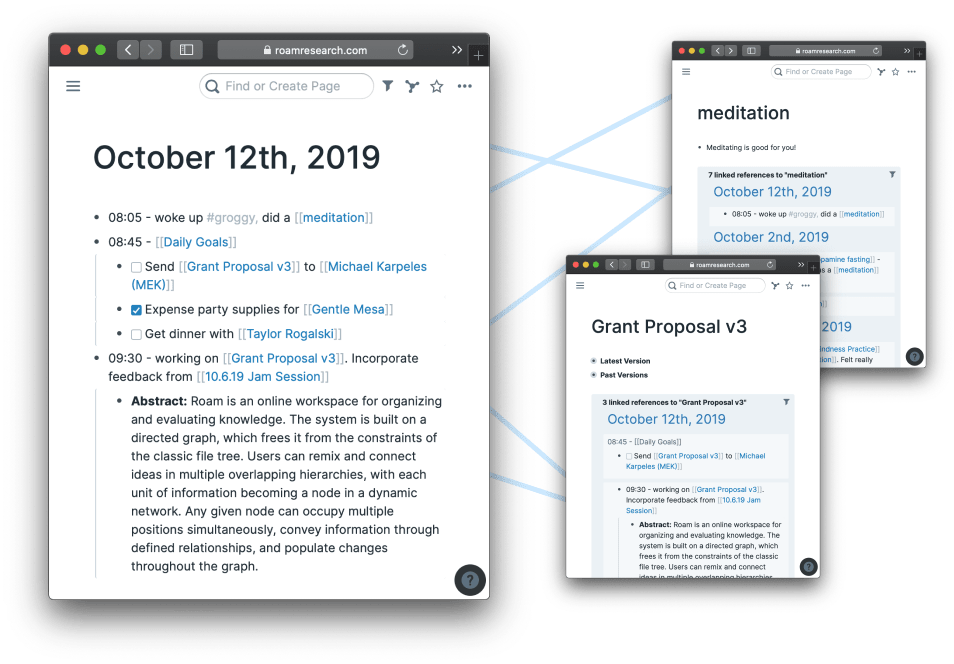
Roam Research is a note-taking application for networked thought.
The way you take notes on Roam is similar to how a brain would processes information. Usually, when you are learning a new concept, your brain will immediately try to create mental connections of other concepts or events related to it. As you consume more information, more and more ideas become intertwined together to form an entire large network of thought.
Likewise, Roam seeks to associate notes with other notes via bi-directional linking, making it easier to connect your ideas. It becomes a proverbial secondary brain —— a place storing all your written thoughts. What’s more, your notes do not just sit there idly like other note apps. Roam encourages serendipity and Spaced Repetition by letting you continuously revisit past notes whenever you call it back with back-linking.
For those tinkerers out there, you can even create your own custom CSS and JavaScript themes! (Shameless plug: check out my theme CyanoRoam on Github :)
Pricing
The bummer is that after their 31-days free trial, they start with a whopping $15/month and $7.50/month for students afterwards. If you are not willing to spend that much money on it, I recommend looking into other Roam alternatives like Obsidian and TiddlyStroll.
(I was lucky enough to have been part of their beta program so my graph is free indefinitely 😁.)
If you are interested to know more about how Roam Research works, you can also check out Ali Abdaal’s video on Roam.
How I Take Notes.
Personal Knowledge System/Building A Second Brain or whatever you want to call it, below are the multiple facets of how I take my notes. See and pick what works for you.
📸Quick Capture
Our brains are constantly coming up with new ideas. Sometimes, this can get very distracting and take away from what we are currently focusing on.
A way I have come up to curb this problem is that whenever I come up with a new idea or inspiration, I will immediately capture them down on Roam.
I keep quotes, reading highlights, podcast insights and everything you can think of. I find this very liberating as it helps to take the load off my brain so I can focus what is important presently.
Then, at the end of the day, I can go back to review whatever I have written the entire day, and decide whether I will add them to the list of stuff to work on.
📚Book/Podcast/Article Notes
This is the most obvious kind of note-taking: writing notes on stuff you read.
Whenever I read, or other content I consume online e.g. podcasts, articles, I try my best to paraphrase and summarize every book. Especially when coming across a foreign concept that I wish to learn more on, I find it best to actively engage with the material for better learning.
Take note (pun intended): When taking notes, paraphrase and try not to refer back to the material at hand. This is the essence behind Active Recall.
⚖️Quantifying My Productivity
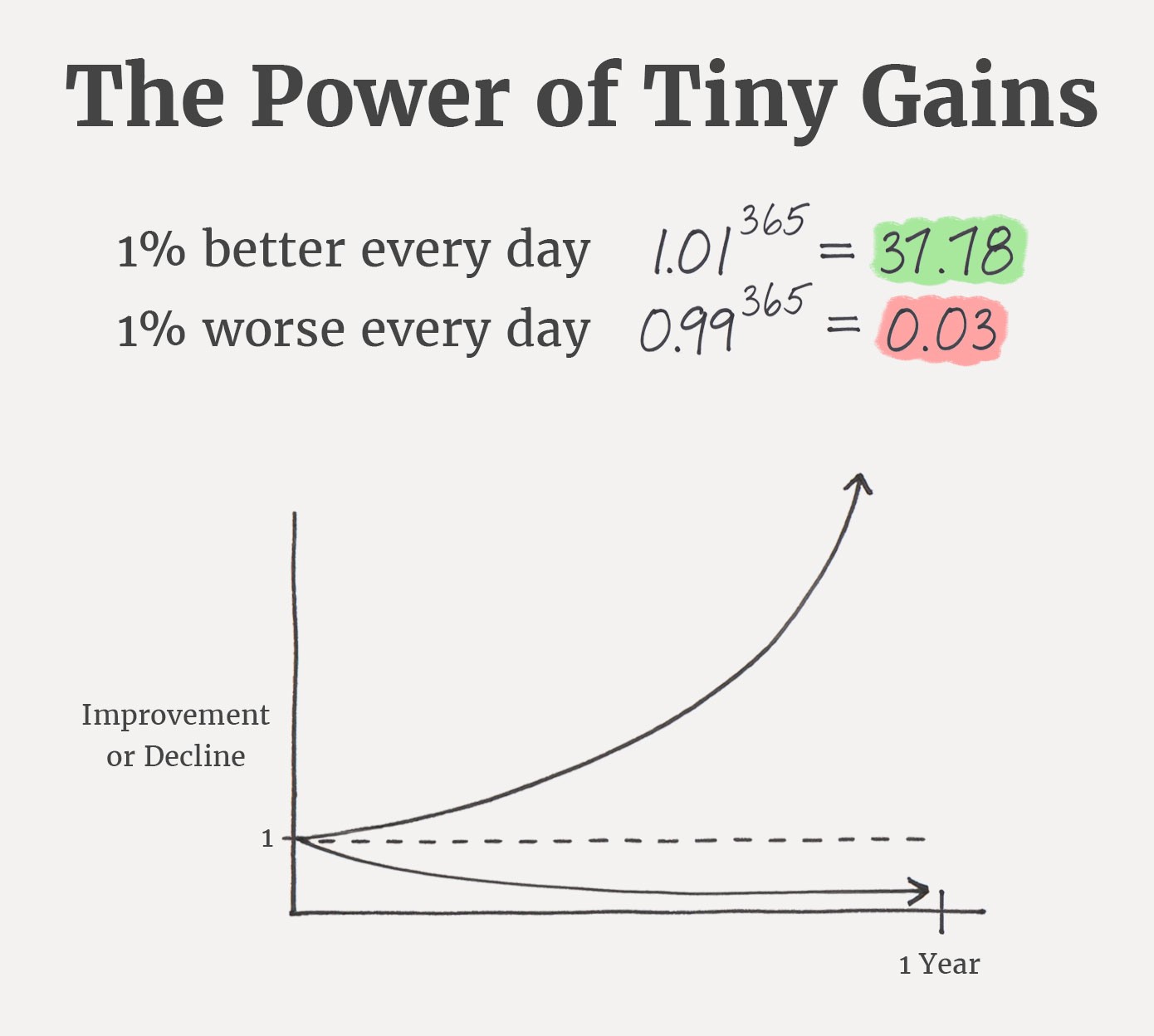
I subscribe to the notion of the 1% Rule: if you improve yourself by 1% everyday for one year, you will end up 3800% better than where you started off a year ago. I first read this from James Clear, the author of the best-selling book, Atomic Habits.
Source:Marginal Gains by James Clear.
"Habits are the compound interest of self-improvement."
Of course, in reality, the metric to quantify your productivity is slightly more unclear, and you might not exactly be 38x better. But the 1% Rule proves how powerful compound interest can be and how it can do wonders to your life.
I follow a simple system of quantifying my output to track my productivity. I have a section called ⏳Timeline of My Life. In there, I record down the notable things that I have learnt or accomplished that day, or when I have reached a certain milestone in my life.
This is especially useful if you wish to do weekly reviews on your personal development.
Looking at all your past notes can give you a birds-eye view of what you have accomplished the entire week. By reviewing, you are applying Spaced Repetition to your learning. Occasionally looking back at the mini-achievements you have done can also do wonders to your motivation and self-esteem :P.
I am considering using a software tool like Airtable in the future to relegate this mini-project to. Maybe one day, I will reach the level of julian.digital.
📝Journaling
As mentioned in my article on journaling, I also use Roam as a tool for writing down my thoughts and reflections. You can read the article here, where I talk more about how I use it to manage my emotional and mental health.
Conclusion
So this is a brief overview of the theories behind how I do my note-taking. I hope you have gained some insights after reading this post, and perhaps even incorporate some of these concepts into your own life.
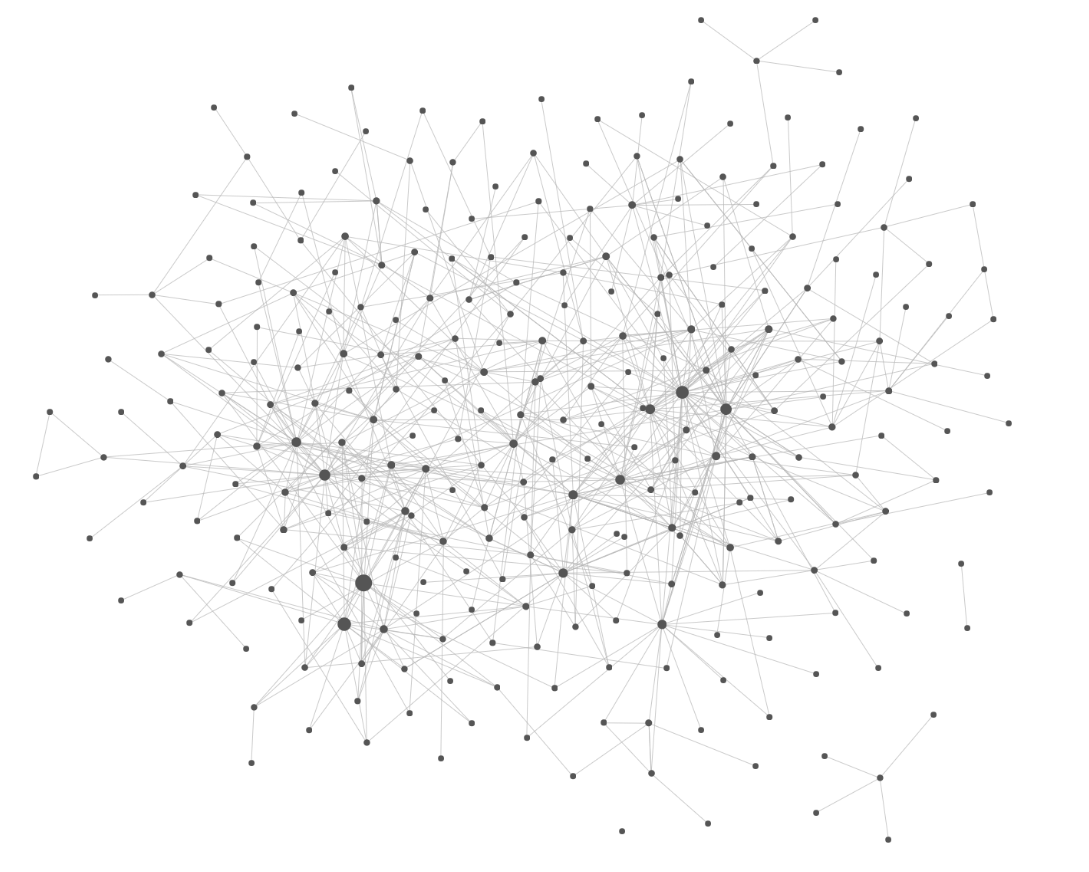
My Roam Graph: An overview of how all my notes are connected in Roam Research.
If you were to try something like BASB or PKM, give time for your ideas to gain momentum before they snowball into an entire network of thought.
Soon enough, all your high-value ideas will be right at your fingertips, ready to be recalled from your secondary brain at any time!
Dunlosky, J., Rawson, K. A., Marsh, E. J., Nathan, M. J., & Willingham, D. T. (2013). Improving Students’ Learning With Effective Learning Techniques. Psychological Science in the Public Interest,14(1), 4-58. doi:10.1177/1529100612453266 ⤴
Iii, H. L., Putnam, A. L., & Smith, M. A. (2011). Ten Benefits of Testing and Their Applications to Educational Practice. Psychology of Learning and Motivation, 1-36. doi:10.1016/b978-0-12-387691-1.00001-6 ⤴
Benjamin, A. S., & Tullis, J. (2010). What makes distributed practice effective? Cognitive Psychology,61(3), 228-247. doi:10.1016/j.cogpsych.2010.05.004 ⤴
Grundspenkis, J. (2007), “Agent based approach for organization and personal knowledge modelling: knowledge management perspective”, Journal of Intelligent Manufacturing, 18(4): 451–457, doi:10.1007/s10845-007-0052-6 ⤴
]]>Ivan Angivanang47@gmail.comJournaling as a tool for self-help.2020-07-05T00:00:00+00:002020-07-05T00:00:00+00:00https://www.ivan-ang.com/journaling-as-a-tool-for-self-helpMore often that not, we would read some blog post on some self-help advice, get really inspired, and then forget about it the next day. So why do some advice stick while others do not?
For self-help to actually work, you have to find the ones that work for you.
A classic example: A common productivity advice would be to wake up at 5 am daily (or some other arbitrary timing). However, this advice may only be useful for early birds, and not necessarily apply to the rest of us. In fact, studies have shown that some people are just biologically more alert in the morning, while others are more of night owl-ers1.
Personally, journaling my thoughts has helped me in generating advice that actually works for me. In a sense, it has become my self-help generator. This is especially helpful when I am feeling especially stuck and confused.
If you have attended therapy sessions before, you might have heard of Cognitive Behavioral Therapy (CBT). Essentially, it is a form of psychotherapy treatment used to identify and change negative thought patterns that have an influence on your emotions and behavior.
In some ways, journaling can be a form of CBT for yourself. Record your thoughts and emotions, and try to recognize thought patterns from that. Then evaluate whether this way of thinking is toxic for your mental health. From there, you are able to gain insights for how to disrupt these negative thinking habits. You will also be able to generate advice for yourself that actually caters to your needs.
Here is a simple framework I like to follow (with an example for explanation):
1. Write down what you are thinking about
Do a brain dump. Regurgitate out all your thoughts and anxieties. This helps to convert your abstract thoughts into tangible issues to be examined.
🗑️Brain Dump:
Today was such an unproductive day. Other than reading some articles, I pretty much did nothing else today. I am feeling terribly guilty right now and it's ruining my mood. Something must be wrong with me! >.<
2. Ask yourself questions.
Try to identify your current thought patterns. Examine your thoughts using Socratic reasoning:
Why am I feeling like this?
Is this problematic? Why?
What assumptions am I making?
Is there another way of looking at this issue?
Why do I feel this way?
I do not want to regret that I'm not living life to the fullest everyday. I guess doing nothing is in conflict with my personal identity of being this hyper-productive person who has his shit together all the time.
3. Repeat
Keep asking and answering yourself. This is the best way to get to the root of the problem.
Is this problematic? How so?
Perhaps. I shouldn't let perfectionism rule my life. This "personal identity" may be too unrealistic of an expectation I am placing on myself. I should not beat myself up too much for being "unproductive", sometimes it is okay to not feel like doing anything at all. I must be more forgiving to myself.
In this example, the advice to self would be to not set too unrealistic expectations for yourself, as doing so will only set yourself up for failure and disappointment. Be kind to yourself.
Conclusion
Most of the time, the best form of self-help advice comes from your own self introspection. This is where we can actually act on the advice and adapt them into our system.
Chronotypes in the US – Influence of age and sex: https://journals.plos.org/plosone/article?id=10.1371/journal.pone.0178782 ⤴